April Book Wrap-Up
Ohh boy, it’s been a while since the last post. Senior year is wrapping up, and between that and getting Tomodochi Life, I haven’t had much time to read or write. But April was an amazing month of reading! Let’s get started, and as per usual, HUGE SPOILERS AHEAD!
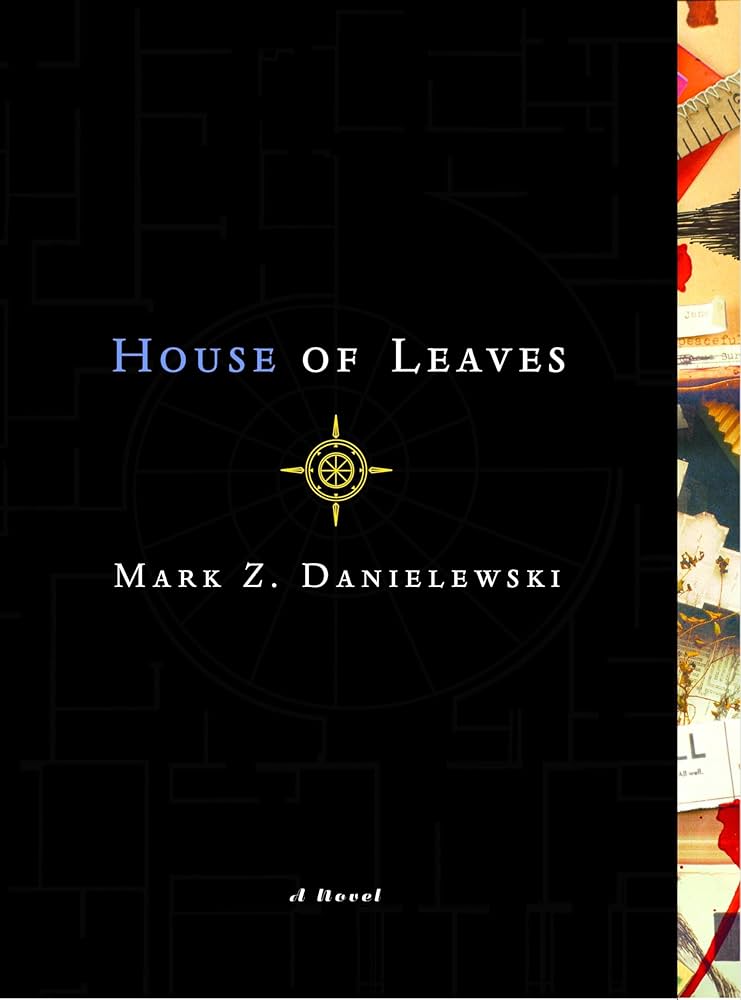
House of Leaves- Mark Z. Danielewski
This book is weird. It’s peculiar, scary, exhilarating, while also being as dense as a textbook. There are so many side stories, weird tangents about physics and minotaurs, changing formatting, even a page that was sheet music! I’m pretty sure I accidentally freaked my roommate out by humming the notes on the page in the middle of the night. But it’s this multimedia, maze within a maze within a maze approach that made this book truly memorable.
At this point, I’m convinced I need to start putting together a theory of mazes because this book is a very interesting addition to the ideas of labyrinths. The labyrinth in the House of Leaves seems to be a projector screen for the mind of whoever enters it. And because people are inherently fearful of the unknown, this fear seems to manifest itself as the labyrinth itself feeling evil. The house seems to take people in its grasp and never let them go, keeping them wandering its dark halls that are inhabited by some unknown horrible creature. This entire idea is kind of similar to how perspective can change whether or not a story is horror, like how Piranesi’s maze is beautiful because it has endless meaning, and how the Library of Babel is horrifying because it has infinite gibberish. The maze itself is neutral, but it’s the perspective of the person entering it that makes it seem nefarious or not.
My favorite part of the entire book though was a little poem containing the book’s title near the end. The second I read that poem, it felt like the meaning of the book just clicked in my head– a very unsettling feeling.
(Untitled Fragment)
Little solace comes
To those who grieve
When thoughts keep drifting
As walls keep shifting
And this great blue world of ours
Seems a house of leaves
Moments before the wind.
I would absolutely recommend this book to anyone who wants to read something scary but also thought provoking.
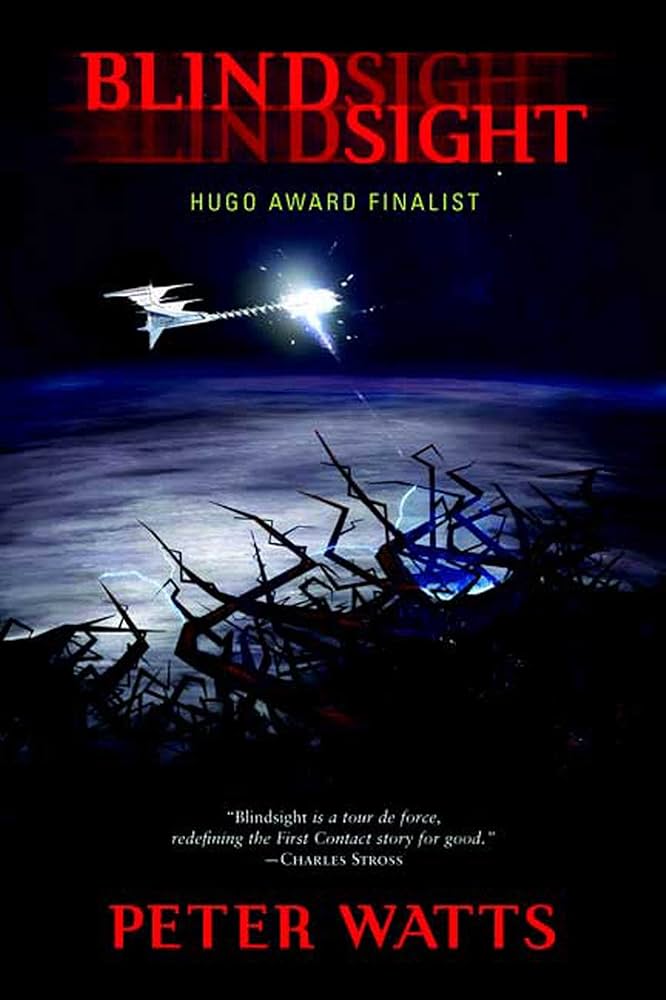
Blindsight- Peter Watts
I found this book because I searched “hard science fiction” on google and this was the first thing that popped up. It was definitely not what I was expecting, but turned out to be another very thought provoking book nonetheless. The entire premise is an exploration of the evolutionary benefit of consciousness; basically, there is this condition people can have called blindsight, where they technically cannot see at all, but can unconsciously process visual information and respond to it. In this book, the main character, Siri, is part of a crew on a mission to make first contact with an alien ship, and these aliens have an extreme version of blindsight.
The creatures aren’t conscious at all. Their bodies don’t process enough energy to sustain a conscious being, but they can still react and respond to stimuli as if they were conscious. They just have a very complex if-this-then-do-that kind of system. Peter Watts makes the argument that there is no evolutionary benefit to having consciousness, and creatures with ‘blindsight’ are much better suited for survival. This is a really chilling thought, and I genuinely wonder how much scientific research has been done into this idea to either disprove or prove its accuracy.
Outside of the science, I feel like this story also had a very strong human element to it. Though Siri is missing half his brain and is incredibly dense, it’s easy to feel empathetic towards him because being socially unaware is still a very human experience. The relationships between the crew members and the characterization of the vampire was also really compelling to me, and I think Watts pulled an Ursula K. Le Guin (my way of describing how the first half of the book has a certain tone, something terrible suddenly happens, and the rest of the book is a completely different experience). In Blindsight, Siri just acts as himself and does his job until halfway through the book, the vampire mission commander physically assaults him brutally. After that, there was a significant tonal shift in the book as Siri is shocked into basically becoming a different person.
Blindsight was an awesome hard sci-fi book, and I can’t wait to see what other masterpieces the genre has!
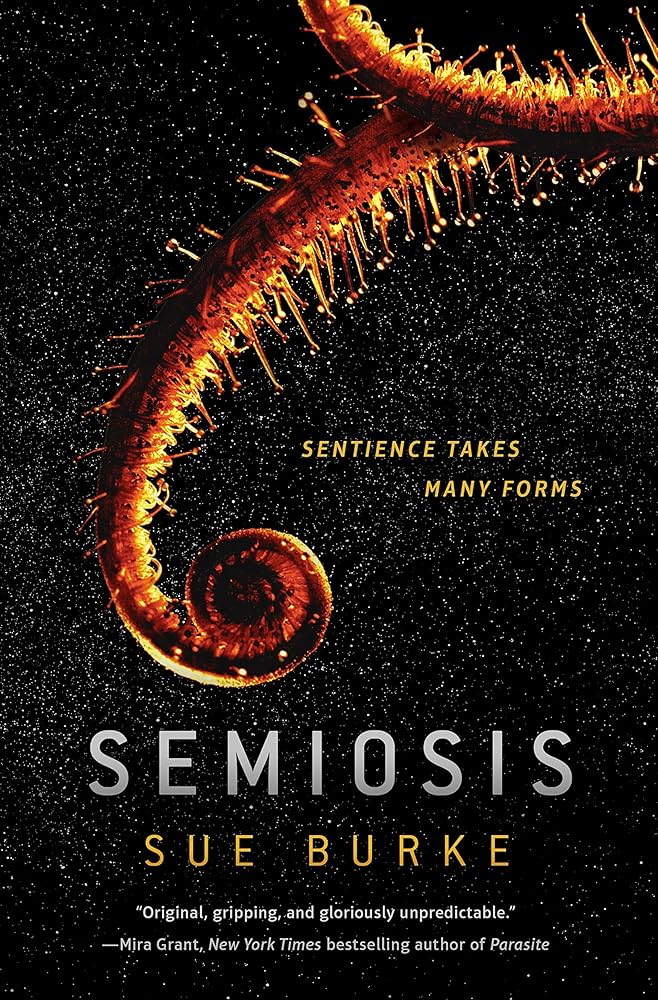
Semiosis- Sue Burke
I really liked Semiosis. Like, really REALLY liked it. This book had some of the coolest scientific worldbuilding I’ve ever read. Basically, humans came to start life over on this planet with sentient plants. The book follows many generations, as the first generation and their manipulative ways are overthrown by the more optimistic second generation, and people begin to form their own society, culture, customs, and more. Throughout these generations, one very advanced bamboo-like plant remains as their benefactor and supporter.
The capabilities of the bamboo are so creative; in one part of the book, moths carry human flesh to the bamboo stems so the plant can analyze the composition of the species. Then, the bamboo produces fruits with specific chemicals that would have the desired effect on humans. This is absolutely mind-boggling! Semiosis is also similar to the Dispossessed, because not only does it do science fiction well, but it’s also a thought experiment on human society-building and psychology. The later generations of humans reject the ways of their ancestors, including war, manipulation, and inequality. Instead, they want to be completely peaceful and engrain this in their moral viewpoints and psychological motivations. Both the anarchist society in the Dispossessed and the human colony in Semiosis require completely different psychologies than the one in our world today to work.
The overall feeling of this book is immaculate. It reminds me a lot of The Green Book, a science fiction novel I read in elementary school. Yes, nature is weird and scary at first, but humans can adapt to the environment, change, and revel in its alien beauty. And this is a much more vague connection, but Semiosis reminded me of the Epic of Gilgamesh. Both follow the tales of the earliest peoples in their respective planets.
If Blindsight doesn’t seem like a good recommendation because it’s too hard, you will absolutely love Semiosis, which is much more accessible. PLEASE read it!
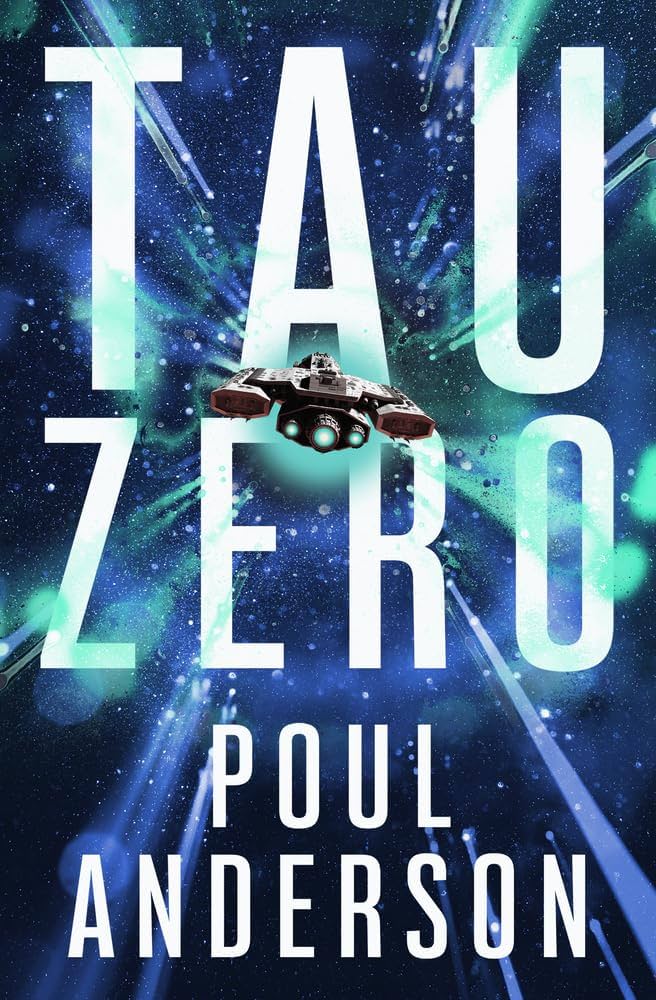
Tau Zero- Poul Anderson
Ok… so this was a goofy one. I didn’t particularly like it. I wish it was just the scientific idea of what would happen if a spaceship constantly accelerated towards the speed of light. Instead, there’s a lot of melodrama in the crew that I didn’t care for. Also, it was just really horny for no reason at all. But that’s about all I have to say for this one.
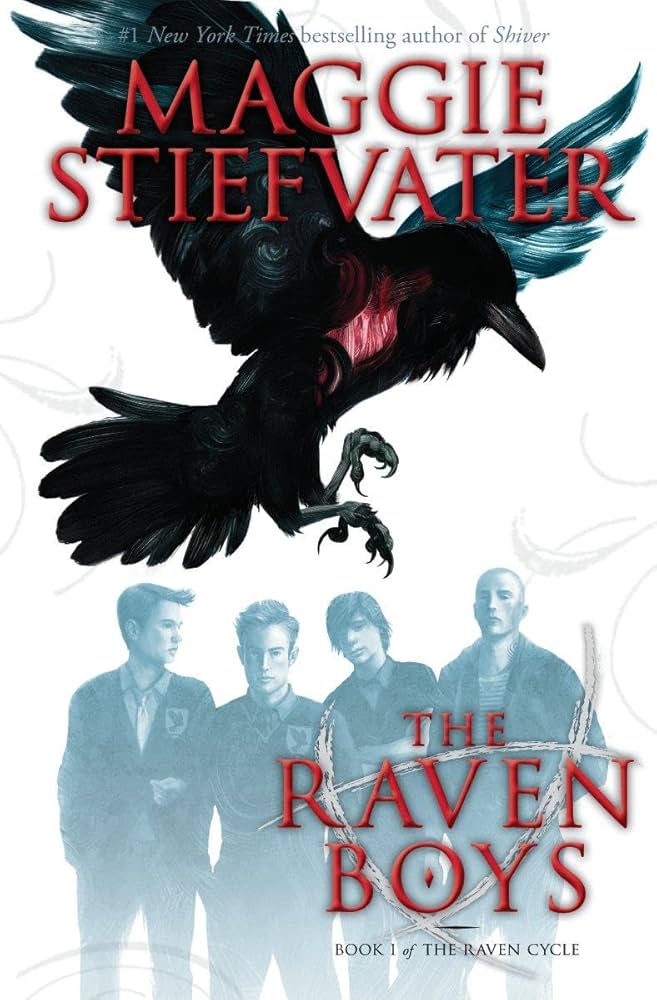
The Raven Boys- Maggie Stiefvater
I genuinely don’t know how this book got on my radar or why I chose to read it. Anyways, I think the best way to describe it is a variant on Kidnapped by One Direction self insert fanfic. It’s pretty middle-school reading level and correspondingly deep, so I wasn’t super interested. I think I’m just the wrong audience for this book, because others enjoy it way more than I do.
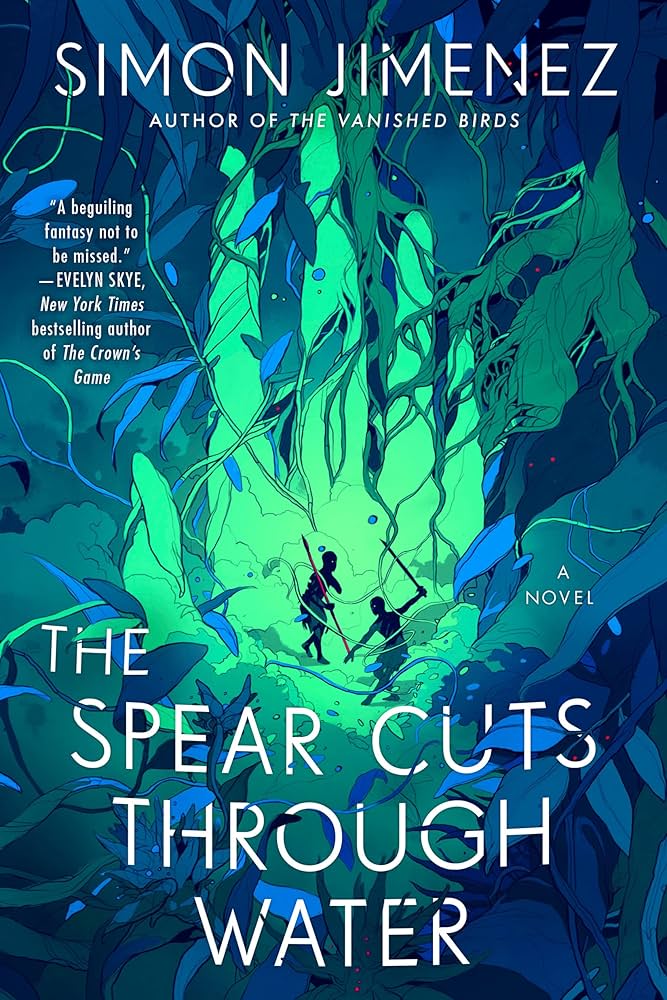
The Spear Cuts Through Water- Simon Jimenez
Perfect. Amazing. Showstopping. The only true equal to the Starless Sea. It took me a long time to find it, but here we are. This is also a weird book. I’ve read many weird books this month. But The Spear Cuts Through Water is written in the second person, where WE, the READER, are part of the story. As we sleep, we are transported to a magical dream theater, where dancers show us the tale of two young heroes on their quest to deliver a magical old lady. Reading this book is like learning a language; there are many intricacies and quirks to the prose, stuff you get better at understanding over time.
And also, I know I’ve already talked a lot about mazes and the Epic of Gilgamesh, but I absolutely have to bring these things up again for this book. The Spear Cuts Through Water plays and messes around with time and space, creating its own labyrinths and garden of forking paths. The world has beauty akin to the Epic of Gilgamesh’s garden of jewels, trees made from lapis lazuli. I know that this is a very scattered way to describe what happens, but again, rather than the linear plot, this book is more about the experience. It’s about useless side quests, random people’s stories coinciding with the main characters.
Rather than spoil it with specific details, all I will say is that I can’t recommend this book enough.