Water Moon
Furious. That is my emotional state after reading this Water Moon. The first couple pages had me believing this fever-dream-fantasy was going to be equivalent to The Starless Sea, one of my favorite books of all time. But for some reason, I couldn’t get into the rest of the book at all! I was genuinely upset at myself that I didn’t like the book, and had to spend a lot of time thinking about why that was. Ultimately, thinking of Water Moon in terms of the standards set by Erin Morgenstern’s The Starless Sea really helped. I will be referencing the latter book a lot in this post, but will still discuss isolated criticisms of the former. Anyways, let’s get started.
The First Couple Pages
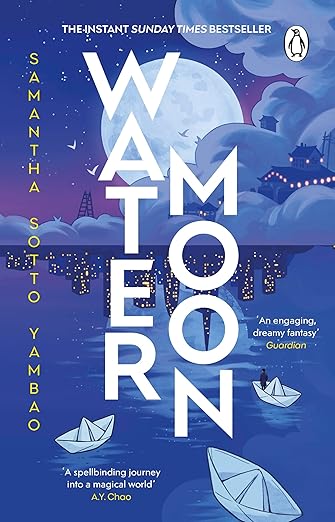
First of all, can we talk about the cover? Even after reading the book, I still get chills looking at it. The modern vs traditional Japanese landscape colored with purple and blue hues is so beautiful. The art immediately sets the dreamy atmosphere, and takes me to a far away place just looking at it. And best of all, the story starts off really strong.
The first chapter title is immediately whimsical. Just like how The Starless Sea starts off with a tragic fantasy romance short story, Water Moon begins with a magical pawnshop:
” The Pawnshop of Almosts and Ifs “
The prose is slow and descriptive, spending time describing trinkets in the shop and secret passages. The characterization of the protagonist is also well done; I was hooked by Hana’s calm and thoughtful personality. Through an interaction with a customer, the nature of the shop is revealed; clients arrive through a magical door to trade their regrets away. But on the day Hana was supposed to inherit the pawnshop, the place is ransacked and her father goes missing. This is essentially the start of the mystery that spans the entire novel- and the start of where things started to go wrong for me.
Enter The Love Interest
When Hana examines the trashed room, Keishin walks in. Immediately, the character description is the most cringy thing I’ve ever read.
” Her gaze traced his sharp jawline and the elegant symmetry of his nose and lips, but the warmth of the pools behind his dark lashes kept her from straying from his eyes for too long. ” (pg 40)
What the hell did I just read? Our main love interest is a mewing alpha chad with perfect model-like features? And the ‘straying from his eyes’ bit makes no sense. Why would warm and inviting eyes be hard to look at? This is where the fantasy really began to fall apart. When I read The Starless Sea, the ‘objective attractiveness’ of the characters was never defined. So I was able to imagine them as people I would see on a regular day outside, not technically perfect like a model, but the unique beauty that all people inherently have. Being able to immerse yourself in the whimsical story and characters is a lot easier.
But immediately, this character description of Keishin creates an icy degree of separation. Suddenly, it’s harder to see him as a person and he becomes more like a caricature of the ‘perfect’ love interest. But this isn’t me extrapolating from limited data. This man has absolutely zero personality and motivations, and fundamentally clashes with the whimsy of the book.
Keishin And His Mommy Issues
Basically the title. His character’s whole shtick is having mommy issues. Basically whenever he has trouble connecting with others, it’s because he has a fear of being left behind, as his mother left him. This is such a basic characterization that has been done a million times before, and because there are no other traits, it just falls flat.
Keishin also doesn’t have any flaws, which I think is the worst mistake when it comes to writing a love interest. He’s a genius, successful, attractive, and has his own apartment in this economy; there are no mistakes to build an internal conflict out of, or make him seem human. Also, his only defining motive is ‘I want something more’, and that is so terribly vague- I can’t do this anymore. It’s giving Disney’s Wish. There is only one way this motive can work, and that’s if it’s paired with some other event or idea to ground it.
In The Starless Sea, Zachary, the main character, also wants something more from his life. However, it stems from a deep regret of his. When walking down the road as a kid, he found a door painted on a wall. The paint was mesmerizing, as if he could reach, grab the handle, and walk inside. But being on the verge of growing up, he decided his instinct was stupid and kept walking. This incident sets up the conflict of the entire book. He spends the next couple of years searching for something more, and realizes whatever he’s missing is beyond the door he neglected to open as a kid. Zachary’s motives are so powerful, because it’s more about the grief of missing a once in a lifetime opportunity than finding a vague ‘something’.
In addition to having the emotional complexity of a brick, Keishin’s verbal language doesn’t mesh well with the fantasy elements. The second line from Keishin’s point of view (in omniscient 3rd person) goes like this:
” The city was an armpit and Keishin was wading through its sweat. ” (pg 46)
Erm, this is supposed to be a poetic dreamlike adventure. Why are we using such unpoetic descriptions to reflect Keishin’s thoughts just because we’re in the human world? When I read the modern and blunt dialogue of this chapter, I could feel my immersion shattering. Again, The Starless Sea portrays the difference between the fantasy world and the human world better… particularly because there is no discernible difference. Zachary talking with his college friends about video games has the same poetic gravitas as him attending a literary ball, dancing with magical people. There is whimsy in what seems to be ordinary, and that’s what makes The Starless Sea so captivating. Both worlds are not meant to contrast, because at the end of the day, the reader has to come back to real life. It is much more powerful to be left with the message that you can turn everyday activities into something beautiful, than the human world being dull and drab.
Keishin is totally boring. But what irks me is that a specific part of his identity holds so much potential to make him a well-rounded character. Unfortunately, that part of him is terribly represented and takes up way too much of the book’s themes. I’m talking about Keishin being a physicist.
Why Is Science Even A Part Of This?
I was hopeful to see a good depiction of a scientist in a fantasy setting; again, there should be no contrast, because it’s absolutely possible to find whimsy in the academic. Take the Webtoon Novae, or the book Emily Wilde’s Encyclopaedia of Faeries. Both do a wonderful job merging magic with science. Unfortunately, this story was not the same. The first red flag was this quote:
” This was what Keishin appreciated the most about physics. It was predictable and reliable. Unlike the weather. ” (pg 47)
The problems with this alone are immense. First of all, Keishin is talking about particle physics. In what reality is particle physics predictable and reliable? Uncertainty and randomness is the very foundation of quantum mechanics! Physics is one of the hardest sciences; as you dig deeper, the more you realize the truth is depressingly out of reach. Additionally, he says physics is predictable while the weather isn’t. Oh brother, guess what? The study of weather is called meteorology. And guess what meteorology is? A BRANCH OF PHYSICS! This passage is unforgivable.
The author makes science a focus point of this book without actually doing anything meaningful with it. Keishan yaps so much, like ‘Oh I’m a curious scientist and I want to do experiments and discover more about this fantasy world because I’m curious’. It’s not at all subtle, and not at all meaningful. But it takes up so much space.
Being a scientist is a lifestyle, and it could have added so much to Keishin’s personality. Working so much in a lab, his appearance could have been sleep deprived and disheveled. At first, his personality could be more introverted and shy, but as Hana gets to know him further, he could go on passionate rants and actually do science rather than telling us how much he wants to. There are so many possibilities, but none of them are even considered!
Because Keishin isn’t a great character, he doesn’t make a good love interest. That’s a shame, because Keishin and Hana’s romance is basically the plot of the book.
Petition To Make Keishin A Cat Sidekick
I stand by what I say in the title, because this would solve the terrible mistake that is the romance in Water Moon. Hana was a great character in the first couple pages, but the second Keishin walked in, her entire personality became dedicated to being in love with him. The connection I had to her character was severed instantly. Also, they were acting like soulmates way too quickly. Consider this quote:
” Hana fit next to him perfectly, a complement of angles and curves. Had he believed in destiny, Keishin might have allowed himself to think that their bodies had been carved exactly for this moment. ” (pg 85)
This was on the first day they met. What happened to getting to know each other? Becoming friends first? I understand what the author is trying to do: make the scale of their romance infinite. But it doesn’t feel large or dramatic when the pacing makes it painfully obvious that they’ve known each other for like three days. The romance also takes up way too much space in the book. It should be an important aspect, yes, but not an overbearing and exhausting sludge to get through.
The Starless Sea shows us exactly how romance should be done. First of all, there are multiple romances that are each developed well in a short time. Zachary and Dorian only have like five scenes where they’re in the same room, and do a majority of their growth away from each other. These few scenes are similar to Water Moon in the sense that their connection is instantaneous and dramatic. However, with the way the book is written, so much time passes between their meetings that the romance isn’t overwhelming. Also, it helps that the scenes are exceptionally well written and lack cringy dialogue about jawlines and lips. There are other romances in the book as well, involving lovers trying to reunite across thousands of years and many obstacles. The slow pacing allows the reader to grasp how timeless love is in The Starless Sea.
Giving the characters a personality and motives outside of love would strengthen the relationship in Water Moon. But it would be way easier to just turn Keishin into a cat sidekick. I’m ALWAYS up for is a girl-and-her cat fantasy adventure, and that way, we don’t have to worry about making Keishin a fully fleshed out character! Additionally, this can be a solution for a different problem in Water Moon…
The Ghibli Problem
I’m cool with books and media trying to emulate the feelings found in other books and media; if Water Moon wants to be Ghibli-esque and have those vibes, that’s fine! But there are two major missteps the book makes that completely breaks the comparison. Let’s take a look at this quote where Keishin plans his visit to Japan:
” Miyazaki Hayao’s Studio Ghibli was at the top of his to-do-list, as it was unthinkable to leave Tokyo without making a pilgrimage to the home of one of his favorite animes, My Neighbor Totoro… But the pond in the pawnshop’s backyard put Catbus [a Ghibli character] to shame. ” (pg 71)
Oh please, if you’re going to be inspired by a Ghibli movie, don’t actually invoke the name of one in your story! When you’re saying the landscape of your story is prettier than a Ghibli movie’s, it becomes obvious that the aesthetic is being stolen rather than being recreated in the author’s own vision. Basically, as a reader, I want to exit the book thinking, “that story reminded me of Howl’s Moving Castle!” rather than being told that to my face. Unfortunately, I didn’t leave the book thinking it was Ghibli-esque for reasons we already discussed. The romance takes up too much space, there is no subtlety, the human world lacks whimsy, and the story takes place in too little time. Taking out the romance would really help with that, because there would be more time left for the fantasy elements. But wait- what are the fantasy elements of this book?
An Unfortunate Lack of Useless Side Quests
The magic in this book is absolutely brilliant. Origami folding time, tattoos inscribing one’s fate, and masked creatures pulling the strings on society. One of the major plot reveals is also amazing. Remember how the pawnshop takes away people’s regrets? Turns out, it takes more than that. Humans are tricked by Hana and her father to give away parts of their souls, that would then be used to create more people in the magical world. The humans who had their souls taken would go about their lives, missing something but never knowing what. See? This is a good basis for an ‘I want something more’ motive! The author clearly has so many good ideas, and that’s why I was so confused when I read through the book for the first time. The fantasy elements were perfect, so why did I not enjoy the book? Aside from my previous critiques, it’s because there wasn’t enough of it.
There is a distinct lack of pointless side quests in Water Moon. For such a complex and dreamy world, characters just need to be thrown in and wander around aimlessly, pointing out little details, and exploring little nooks and crannies. Because Water Moon spends so much time moving from one place to the other to further the plot, the reader can’t immerse themselves for long enough to get attached. Let’s talk about The Starless Sea; the main goal is to go through that painted door, but Zachary spends so much time just walking around the underground library and exploring because he feels like it. We see rooms full of miniature objects, strange Russian dolls on shelves, abandoned ballrooms, statues that move when you solve puzzles, and so much more. The plot pauses to allow the reader to experience the world for themselves.
I believe this is exactly what Water Moon could have benefitted from. Adding more fantasy and slowing the pace could have helped the author create the world better. Additionally, adding more characters and different point-of-views might help as well! Yes, Hana and Keishin can still be the central couple, but having important side characters with their own involvement in the world can help distribute the weight of the singular relationship.
All In All
Wow. I went from absolutely being a fan of the first couple pages to writing a 2000 word criticism of this book. Fever-dream-fantasies are my absolute favorite, and I’m still looking for something that can match The Starless Sea. Unfortunately, Water Moon was not it. But I do hope the author continues to write more works like this and hone her craft, because Water Moon genuinely has such a great story inside of it. It just needs some help to get out.